

Horizontal Condenser
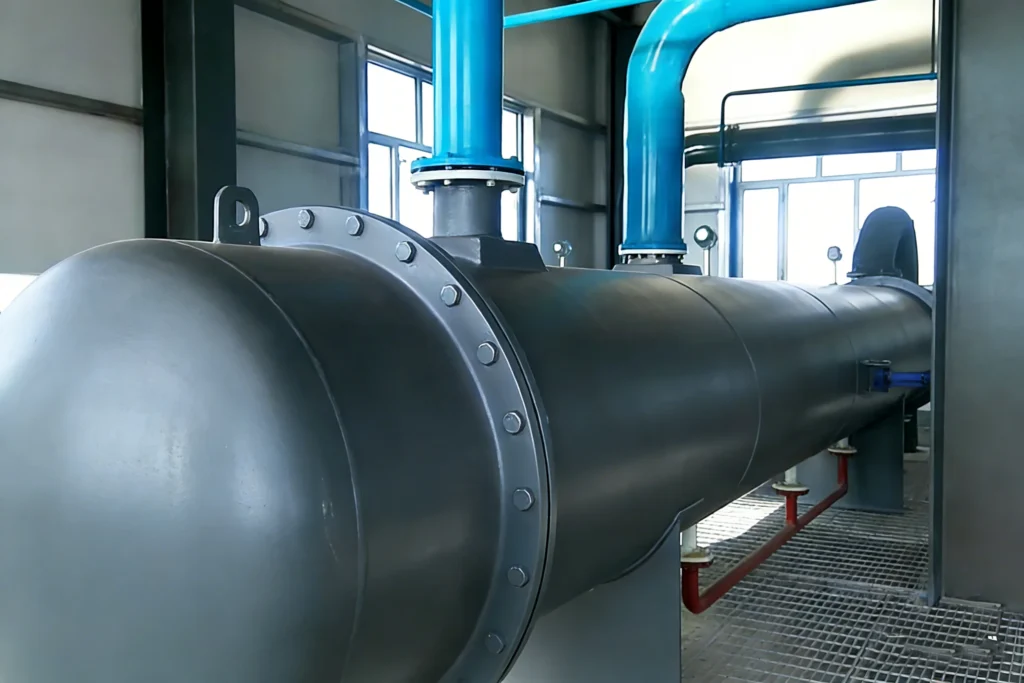
What is a Horizontal Condenser?
The horizontal condenser is a typical form of shell-and-tube heat exchanger, characterized by its horizontally arranged cylindrical shell and heat exchange tube bundle. Hundreds or even thousands of heat exchange tubes are arranged inside the shell, fixed by tube sheets at both ends and sealed with channel boxes; cooling water (or chilled water) flows at high speed inside the tubes, while high-temperature solvent vapor enters from the upper part of the shell and condenses on the outer surface of the tube bundle. In the edible oil extraction process, the horizontal condenser is usually installed between the evaporation system and the solvent recovery unit, occupying the “throat” position of the entire solvent circulation loop.
Why Does the Horizontal Condenser Significantly Save Energy in Edible Oil Extraction Complete Equipment?
In the edible oil extraction production process, the recycling efficiency of solvent (usually n-hexane) directly determines the economic benefits and environmental compliance of enterprises. As the core equipment of the evaporation section, the horizontal condenser undertakes the task of rapidly condensing high-temperature solvent vapor into liquid solvent, enabling its recycling.
A high-performance horizontal condenser can not only significantly reduce solvent loss (solvent consumption per ton of raw material can be as low as less than 2kg) but also reduce steam and cooling water consumption — this is precisely the key link in modern oil processing enterprises’ pursuit of “cost reduction and efficiency increase.”
Working Principle of Horizontal Condenser
1. Medium Flow:
- Tube Side: Cooling water flows at high speed inside the heat exchange tubes;
- Shell Side: High-temperature solvent vapor enters from the upper part of the shell and condenses upon contact with the outer wall of the tube bundle.
2.Heat Exchange Process:
Solvent vapor releases latent heat, condenses into liquid, and collects at the bottom of the shell for discharge; cooling water absorbs heat, its temperature rises, and is sent to the circulating cooling system for cooling and reuse.
3.Non-Condensable Gas Discharge:
An exhaust pipe is provided at the top of the shell, which can be connected to a vacuum system or a free discharge port, to promptly discharge small amounts of non-condensable gases and ensure stable condensation pressure.
Structural Characteristics of Horizontal Condenser
| Component | Design Features | Value to Oil Extraction Process |
| Shell | Carbon steel/stainless steel welded, horizontal cylinder | Stable pressure bearing, suitable for negative pressure conditions |
| Heat Exchange Tubes | Seamless steel tubes, stainless steel tubes or high-efficiency finned tubes | High thermal conductivity, solvent corrosion resistant |
| Tube Sheet | Flanged connection or welded with shell | Facilitates tube bundle core pulling, cleaning and maintenance |
| Baffle Plate | Segmental or annular arrangement | Increases shell side flow velocity, enhances heat transfer |
| Channel Box | Standard flanged head, detachable | Convenient for inspection and scale cleaning |
Core Advantages of Horizontal Condenser
- High Heat Exchange Efficiency:Adopts high-efficiency heat exchange technology to transfer heat from solvent vapor to cooling medium
- Easy Maintenance and Cleaning:The horizontal structure allows the tube bundle to be pulled out from one end; even after long-term operation with wax accumulation on the shell side and scaling on the tube side, rapid online or offline cleaning is possible.
- Small Footprint:Compared to vertical tower condensers, the horizontal arrangement can be installed on the second floor or roof of the plant, saving indoor production space.
Maintenance Points
- Regular Drainage: Solvent may carry a small amount of meal powder or gum; a drain port should be provided at the bottom of the shell, with discharge once a week.
- Scale Treatment: When cooling water hardness is high, the tube side is prone to calcium carbonate scaling; chemical cleaning should be performed quarterly.
- Leak Detection: Pay special attention to the expanded joints between tube sheet and heat exchange tubes; conduct an airtightness test annually.
- Winter Anti-Freezing: Ensure to drain accumulated water from the tube side during shutdown periods to prevent freezing cracks.
| Model | Heat Exchange Area (㎡) | Tube Specification (mm) |
| YLNW40 | 40 ㎡ | 32*6000 mm |
| YLNW100 | 100 ㎡ | 25*6000 mm |
| YLNW150 | 150 ㎡ | Ф25*2*6000 mm |
| YLNW200 | 200 ㎡ | Ф25*2*6000 mm |
| YLNW240 | 240 ㎡ | Ф25*2*6000 mm |
| YLNW250 | 250 ㎡ | Ф25*2*6000 mm |
| YLNW300 | 300 ㎡ | Ф19*1.8*6000 mm |
| YLNW400 | 400 ㎡ | Ф19*1.8*6000 mm |