

Palm Kernel Oil Bleaching Process Explained: Adsorption Bleaching Principle and Refining Equipment Selection Guide
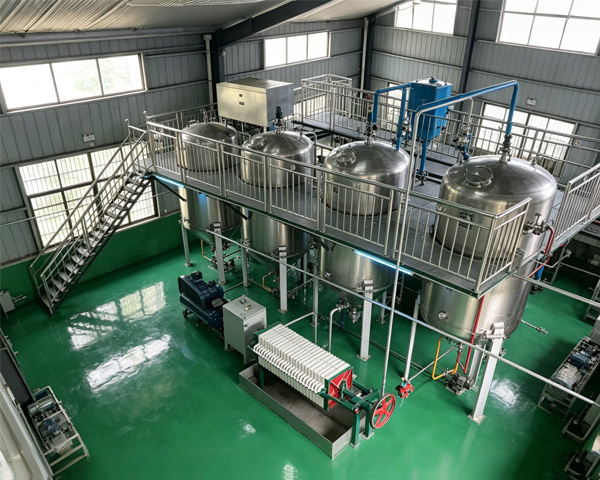
In the refining process of palm kernel oil, bleaching is a key step that determines the appearance quality and market value of the finished oil. Unrefined crude palm kernel oil contains various pigments and impurities, resulting in a dark color and poor stability. Only through a scientifically designed bleaching process can it be transformed into high-quality edible oil with bright color and stable quality.
This article focuses on the core principles, process flow, key parameter control, and equipment selection for palm kernel oil bleaching, helping you fully understand how to achieve efficient bleaching through palm kernel oil refining equipment.
I. Why Does Palm Kernel Oil Need Bleaching?
The main component of edible oil – triglyceride – is colorless or white by itself. The dark color of crude palm kernel oil is due to the presence of various pigment substances, mainly including:
– Natural pigments: chlorophyll, carotenoids, etc.
– Organic degradation products: decomposition products of proteins, carbohydrates, phospholipids, etc.
The function of the bleaching process goes far beyond color improvement. During palm kernel oil refining, bleaching can also remove trace metal ions, residual soapstock, gums, oxides, and other impurities. This process reduces the peroxide value of the oil, improves its flavor, enhances its oxidative stability, and creates optimal conditions for subsequent deodorization and hydrogenation stages. Therefore, bleaching is an indispensable step in converting crude palm kernel oil into high-quality refined oil.
II. Core Method of Palm Kernel Oil Bleaching: Adsorption Bleaching
Currently, the most widely used bleaching method in industry is adsorption bleaching. This method utilizes substances (called adsorbents) that have a strong selective adsorption affinity for pigments, effectively adsorbing and removing pigments and other impurities from the oil under controlled conditions.
1. Common Adsorbents
– Activated clay (activated bleaching earth): The most commonly used adsorbent in the edible oil bleaching industry, produced by acid activation of bentonite raw materials.
– Activated carbon: Has a dense porous structure and a very high bleaching coefficient. It is particularly effective at removing red pigments from oil and leaves no residual off-flavors after bleaching. However, due to its high cost, high oil absorption rate, and slow filtration speed, it is usually not used alone. Instead, it is often mixed with activated bleaching earth in a ratio of about 1:10 to 1:20.
2. Key Operating Parameters for Bleaching
Adsorption bleaching of palm kernel oil must be carried out under vacuum conditions. The key parameters are controlled as follows:
| Parameter | Control Range |
| Bleaching temperature | Optimal approx. 110°C, effective range 105-115°C |
| Bleaching time | 20-30 minutes |
| Vacuum degree | Absolute pressure 6.6-9.3 kPa |
| Adsorbent dosage | Activated clay addition is typically 2%-3% of oil weight |
III. Palm Kernel Oil Bleaching Process Flow
In a complete edible oil refining production line, the bleaching process must be coordinated with degumming, deacidification, deodorization, and other processes. The standard refining process is as follows:
Crude palm kernel oil → Degumming → Deacidification → Bleaching → Deodorization → Refined finished oil
Throughout the bleaching process, temperature is automatically controlled and regulated, and the filtration system operates fully automatically. This allows the entire process to be seamlessly connected, including automatic oil feeding, circulation, filtration, cake blow-down, and residue discharge.
If you are planning a palm kernel oil refining production line, it is crucial to choose complete equipment with an advanced bleaching section.
IV. Technical Advantages of Huatai Bleaching Tower
Henan Huatai Grain and Oil Machinery Co., Ltd. has accumulated extensive technical experience in the design and manufacture of bleaching towers. Huatai’s self-developed bleaching tower has the following outstanding features:
1. Reasonable Structural Design
The bleaching tower has a reasonable structural design, making it easy to operate. It adopts a fully enclosed structure and can be configured with either a power-driven agitation mechanism or a passive (non-powered) mixing design. The internal tower structure ensures that the bleaching earth tumbles evenly, preventing sedimentation.
2. Complete Vacuum System
Equipped with a powerful vacuum system that effectively prevents oil oxidation and deterioration at high temperatures, ensuring optimal bleaching results and excellent oil quality.
3. Multiple Material Options
Depending on customer requirements, the equipment can be manufactured from carbon steel or stainless steel to meet the specific processing needs of different oil types.
As one of the core palm oil refining equipment units, the Huatai bleaching tower has been successfully applied in numerous projects.
V. Factors Affecting the Bleaching Effect of Palm Kernel Oil
In actual production, the main factors affecting the bleaching effect include:
1. Bleaching temperature: Too low a temperature results in insufficient adsorption activity; too high a temperature may cause oil oxidation. The ideal temperature is around 110°C.
2. Bleaching time: Too short a time leads to incomplete adsorption; too long a time increases oil loss. Effective time is controlled within 20-30 minutes.
3. Quality and dosage of adsorbent: The activity, specific surface area, and dosage of the adsorbent directly affect the bleaching effect. The appropriate type and amount of adsorbent must be selected based on the quality of the crude oil.
4. Pretreatment quality: Oils that are insufficiently degummed or deacidified will have residual gums and soapstock, which increase adsorbent consumption and reduce the bleaching effect.
5. Mixing uniformity: The more thoroughly the oil and adsorbent are mixed, the better the bleaching effect. Huatai uses a two-stage mixing system – pre-mix tank + bleaching tower – ensuring full contact between the oil and adsorbent.
VI. Core Advantages of Huatai Palm Kernel Oil Bleaching Refining Equipment
As a leading domestic manufacturer of edible oil refining equipment, Henan Huatai has extensive practical experience in the palm kernel oil bleaching field:
1. Comprehensive Range of Refining Equipment
Huatai offers batch, semi-continuous, and full-continuous refining equipment that can be customized according to oil type and operational requirements. The equipment processing capacity ranges from a few tons to several thousand tons, suitable for palm oil, palm kernel oil, peanut oil, rapeseed oil, soybean oil, and many other oils.
2. Leading Energy-Saving and Environmental Protection Technology
The fully automatic palm oil refining equipment uses waste heat recovery technology to minimize steam consumption. The vacuum system adopts freezing vacuum or cold water vacuum technology, significantly reducing steam consumption and wastewater discharge.
3. Highly Automated Control System
The entire production line is highly automated, using a fully computer-controlled and displayed system. Key parameters such as temperature and flow rate are automatically controlled and regulated, and all operations can be performed in the central control room.
4. Environmentally Friendly Deodorization Design
The bleaching section integrates a deodorization system to eliminate odor pollution generated during bleaching earth cake blow-off, fully complying with environmental standards.
5. Global Service Network
Huatai products have been exported to more than 70 countries and regions worldwide. The company has successfully undertaken numerous international projects, such as building a 100-ton-per-day palm oil refinery in the Democratic Republic of the Congo and a palm kernel oil pressing and refining line in Ghana, accumulating rich experience in overseas project execution.
Palm kernel oil bleaching is a critical step in the edible oil refining process, directly affecting the quality and market competitiveness of the final product. Scientific process design, advanced bleaching equipment, and strict process control are the core elements to ensure effective bleaching.
With over 38 years of industry experience, leading R&D capabilities, and a global service network, Henan Huatai Grain and Oil Machinery Co., Ltd. provides palm kernel oil processing enterprises with comprehensive solutions – from process design and equipment manufacturing to installation, commissioning, and technical training.
If you have any needs regarding palm kernel oil bleaching processes or palm kernel oil refining equipment, please contact Huatai. We will be pleased to provide expert consulting services.