

Flaxseed Oil Refining Production Line Investment Cost: Batch, Semi-Continuous, and Full-Continuous Compared
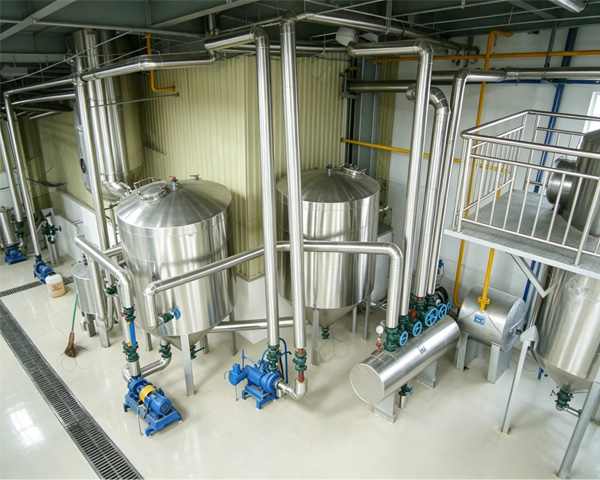
When investing in a flaxseed oil refining plant, the first question you face is: Which production mode should you choose? Batch, semi-continuous, or full-continuous? What are their respective investment costs? Which one best suits your capacity and budget?
This article will provide you with a detailed comparison of the investment costs, technical characteristics, and application scenarios of three types of flaxseed oil refining production lines, and explain the complete process from degumming to deodorization, helping you make an informed decision.
I. Why Is Flaxseed Oil Refining Necessary?
Crude flaxseed oil (obtained by pressing or solvent extraction) contains phospholipids, free fatty acids, pigments, and odorous substances. Direct use leads to foaming, smoking, and blackening when heated, and the shelf life is extremely short. Through the four steps of degumming, neutralization, bleaching, and deodorization in a flaxseed oil refining production line, you can obtain refined oil that is light yellow, clear and transparent, with a high smoke point (215–220°C) and long shelf life (18–24 months), suitable for high-temperature cooking, food processing, and health products.
Whether you plan to process 1 ton or 100 tons per day, choosing the right flaxseed oil processing equipment is the key to success.
II. Investment Cost Comparison of Three Refining Production Lines
Depending on production scale, automation level, and equipment configuration, flaxseed oil refining production lines are mainly divided into three types. The following are investment cost references (unit: USD 10,000):
| Comparison Item | Batch | Semi‑continuous | Full‑continuous |
| Daily capacity | 1–10 tons | 10–30 tons | 30–100 tons |
| Equipment investment | 50–200k | 200–800k | 800–2000k |
| Land & building | 80–140k | 140–300k | 300–850k |
| Installation & commissioning | 15–50k | 50–160k | 160–450k |
| Total initial investment | 145–390k | 390–1260k | 1260–3300k |
| Payback period | 3–5 years | 4–6 years | 5–7 years |
| Main advantages | Flexible investment, small footprint, low technical threshold, suitable for small batches & multiple varieties | Balances economy and flexibility, can process multiple oil types | High economies of scale, stable product quality, low labor cost, high automation |
| Applicable scenarios | Small oil mills, start-ups, specialty oil production | Medium oil mills, factories with multiple product types | Large industrial refineries, single‑variety high‑volume production |
As can be seen from the table, batch refining equipment has the lowest initial investment, suitable for users with limited budget or small throughput; semi‑continuous strikes a balance between cost and flexibility; full‑continuous refining equipment, although the highest in investment, has the lowest long‑term operating cost and is suitable for large‑scale production.
III. The Four Core Process Steps of Flaxseed Oil Refining
Whichever production line you choose, flaxseed oil refining includes the following four basic sections. The equipment for each section is an important part of the production line.
1. Degumming
Removes colloidal impurities such as phospholipids and proteins from crude oil. Common methods: water degumming, acid degumming, or enzymatic degumming. After degumming, phospholipid content drops from 0.5–1.0% to below 0.01%. Core equipment includes degumming tanks, centrifuges, etc. Choosing efficient degumming equipment can significantly reduce the load on subsequent sections.
2. Neutralization (Alkali Refining Deacidification)
Adds alkali solution (sodium hydroxide) to react with free fatty acids to form soapstock, which is then removed by centrifugation. After neutralization, free fatty acid content drops from 2–5% to below 0.1%. Two process modes: low‑temperature long‑time mixing (suitable for medium acid value) and high‑temperature short‑time mixing (suitable for high acid value). Core equipment includes alkali refining reactors and centrifugal soap separators.
3. Bleaching (Decolorization)
Under vacuum, uses adsorbents such as bleaching clay and activated carbon to remove pigments, residual soapstock, and oxidation products. Typical parameters: bleaching clay addition 1–3%, temperature 100–110°C, time 20–30 minutes. After bleaching, the oil color becomes significantly lighter and stability improves. Core equipment includes bleaching tanks, vacuum systems, and leaf filters.
Under high temperature (180–240°C) and high vacuum (2–5 mbar), direct steam is introduced to remove odorous substances and residual free fatty acids by steam distillation. After deodorization, the smoke point rises to 215–220°C, the flavor is light and mild, and shelf life is extended. Core equipment includes deodorization towers, vacuum systems, and heat recovery systems.
Note: Deodorized flaxseed oil must be cooled immediately and protected with nitrogen to prevent oxidation.
IV. Refined Flaxseed Oil vs. Cold‑Pressed Flaxseed Oil vs. Crude Flaxseed Oil
To help you understand the value of refining, here is a key comparison of the three product types:
| Parameter | Refined Flaxseed Oil | Cold‑Pressed Flaxseed Oil | Crude Flaxseed Oil |
| Smoke point | 215–220°C | 160–170°C | 150–160°C |
| Free fatty acids | ≤0.1% | 0.5–2.0% | 2–5% or higher |
| Phospholipid content | ≤0.01% | 0.5–1.0% | 1–2% |
| Shelf life | 18–24 months | 6–12 months (needs refrigeration) | Very short, prone to rancidity |
| Main uses | High‑temperature cooking, food processing, health products | Cold dishes, direct consumption | Industrial applications, biodiesel |
Although refined flaxseed oil has a slightly lower α‑linolenic acid content (50–55%) than cold‑pressed oil (57–60%), its stability and high‑temperature performance advantages make it more suitable for industrial production and diverse cooking scenarios.
V. Uses and Safety of Refined Flaxseed Oil
Main Uses
– Food industry: Frying oil (french fries, instant noodles), baking oil, salad dressing base oil, functional foods and health products (ω‑3 supplements, softgels)
– Other industries: Eco‑friendly coatings, wood varnish, cosmetics (skin creams, lip balm base oil)
Safety
Refined flaxseed oil is completely safe for consumption. Major food safety authorities such as the US FDA, the European EFSA, and China’s GB 2716 recognize it as a safe edible oil. During production, harmful substances such as heavy metals and toxins are strictly controlled. Refined oil produced by regular manufacturers can be used with confidence.
VI. How to Choose the Most Suitable Flaxseed Oil Refining Production Line for Your Needs
Based on your actual situation, refer to the following recommendations:
– Start‑up or small scale (1–10 t/d): Choose a batch production line. Low investment, small footprint, flexible operation, suitable for small batches and multiple varieties. Recommended configuration: degumming tank, alkali refining tank, batch bleaching tank, batch deodorizer.
– Medium scale (10–30 t/d): Choose a semi‑continuous production line. Balances investment and efficiency, can process multiple oil types, moderate automation. Recommended configuration: continuous degumming centrifuge, continuous alkali refining system, continuous bleaching tower, semi‑continuous deodorization tower.
– Large industrial scale (30–100 t/d): Choose a full‑continuous production line. Although initial investment is high, labor cost is low, product quality is stable, energy consumption is low, and long‑term returns are optimal. Recommended configuration: full‑continuous flaxseed oil refining equipment with automatic control system.
Whether your daily processing capacity is 10 tons or 500 tons, Henan Huatai Group can tailor a flaxseed oil refining production line according to your specific production goals and budget requirements, providing a one‑stop service from process design to equipment installation, commissioning, and training.
Choosing the type of flaxseed oil refining production line is essentially a balance between investment cost and operational efficiency. Batch is suitable for small scale and low budget; semi‑continuous combines flexibility and economy; full‑continuous exchanges higher upfront investment for long‑term scale benefits.
Through the comparison in this article, you can make the most reasonable choice based on your own capacity and budget. For a free consultation and detailed cost analysis, please contact the Huatai engineering team. We will help you transform crude flaxseed oil into high‑quality refined oil that meets international quality standards, maximizing your return on investment.