

The Hidden Yield Killer in Palm Oil Extraction: How Screw Press Wear Silently Erodes Your Profits
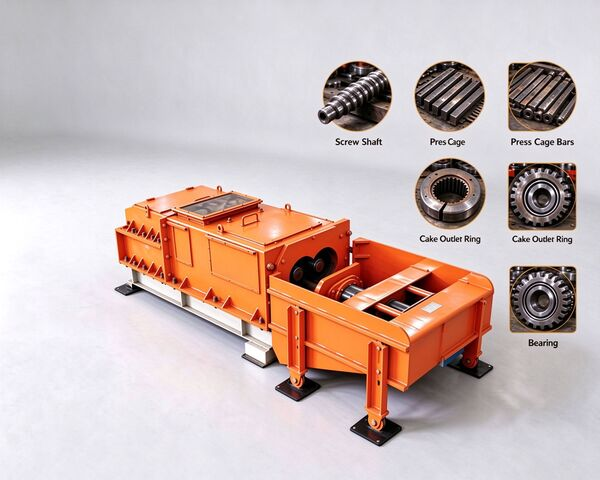
In a palm oil mill, the screw press may be the most “silent” piece of equipment. It lacks the roar of a boiler and the vibration of a centrifuge, yet its wear condition silently determines how much oil you can extract from every ton of fresh fruit bunches.
Most mill managers focus on sterilization temperature, pressing pressure, and residual oil in the cake, but few look at a more fundamental question: How many hours has the screw press been running? How worn is it?
A tracking study at PT Selago Makmur Plantation, an Indonesian palm oil mill, delivered a sobering answer: in the first 368 hours of screw operation, oil loss in press fiber was about 5.39%; by 531 hours, oil loss climbed to 7.08% – an increase of over 31%. Linear regression analysis found a very strong positive correlation between screw running time and oil loss (r=0.9937, R²=98.76%). More critically, the mill’s oil loss limit was set at 6%, and the screw crossed that red line at just 411 hours. After replacing the screw, oil loss dropped from 7.66% to 4.16% within 10 hours, further confirming the causal relationship between screw wear and oil loss.
I. How Does Wear “Eat” Your Profits?
The working principle of a screw press seems simple: a rotating screw pushes the fruit mash toward a conical outlet, applying pressure in a gradually shrinking space to squeeze oil out of the cells. But this process hides a physical paradox: the part of the screw that wears fastest is precisely the part that applies the most pressure. A study based on Autodesk Inventor simulation modeling confirmed that the maximum wear area is located at the end of the screw where it bears direct pressure from the cone.
The gap between the screw and the press cage is the core parameter determining pressing pressure. As the wear-resistant layer on the screw surface gradually wears away, the gap increases, the tension in the pressing section drops, oil cannot be fully squeezed out, and it remains in the cake and is discharged with the fiber. A technical article published by the Malaysian Palm Oil Board (MPOB) points out that the two key monitoring parameters for pressing performance are broken kernel rate and oil loss in the cake, with ideal operating conditions requiring a broken kernel rate below 20% and cake oil loss (wet basis) below 4.5%. Wear-induced gap increase often pushes cake oil loss above this threshold.
The effect of wear on oil loss is gradual, cumulative, and quantifiable. Data from the Sebanga Multi Sawit mill in Indonesia shows that actual screw service life varies greatly between mills – the manufacturer’s recommended standard life is 1,000 hours, but this mill, through optimized operation, achieved an actual service life of 1,300–1,500 hours. PT Selago Makmur Plantation, on the other hand, set the maximum screw life at 600 hours. Behind this difference lies a combination of operating parameters, raw material characteristics, and maintenance strategies.
More insidiously, wear not only affects oil loss but also increases the burden on downstream stages. When residual oil in the cake rises, the downstream solvent extraction system must handle more oil, steam consumption increases, and the solvent recovery load becomes heavier. The cost impact of a worn screw press propagates along the entire production line.
II. The “Culprit” of Wear: The Abrasiveness of Palm Fruit
To understand why screw wear in palm oil mills is so severe, one must first understand the physical properties of palm fruit.
Palm fruit mesocarp contains large amounts of hard fibers. These fibers rub against the screw surface at very high frequency and pressure during pressing, creating typical high-stress abrasive wear. At the same time, palm kernels (unbroken nuts) are much harder than the screw material. When pressing parameters are not set correctly, kernels can act as “grinding media” between the screw and the press cage, accelerating wear.
This abrasive environment demands that the screw material achieve an extremely high balance of hardness and toughness. MPOB research explicitly states that hardfacing methods used in the palm oil industry for wear parts such as press screws often fail to achieve expected life because they do not accurately identify the wear factors. Simple repair welding only restores geometric dimensions but does not fundamentally increase surface hardness, causing the screw to wear again in a short time.
Wear types in the palm oil industry are not limited to abrasive wear. According to MPOB technical literature, the main wear mechanisms faced by press screws include adhesive wear, abrasive wear, erosive wear, cavitation wear, delamination wear, corrosive wear, and fretting wear. Among these, abrasive wear and erosive wear are the dominant factors in early screw failure. The main wear parts listed by MPOB include press screws, press cages, digester arms and shafts, digester liners, wear plates, and conveying screws.
A study on screw wear rate provides specific quantitative data: for a US-12 type screw press made of cast steel (hardness 215 BHN), operating 14 hours per day for a cumulative 364 hours, the volumetric wear rate on the screw surface was approximately 357.7 mm³/day, with monthly wear volume reaching 10,733 mm³. Another study predicted that the daily wear volume of the screw is approximately 66.89 mm³/day, with the most severe wear located at the screw tip.
III. Hardfacing: The Material Science of “Extending Life” Instead of “Replacing Parts”
When facing screw wear, the most traditional approach is “replace when worn” – buying a new screw or simple repair welding. But this approach has a fundamental problem: ordinary welding materials cannot match the high-stress abrasive wear conditions of a palm oil mill.
The core of hardfacing technology lies in material selection. For the high abrasive wear conditions in palm oil mills, flux-cored wires containing chromium carbides are an ideal choice. Take VAUTID 90 as an example – this material is specifically designed for the special wear conditions of the palm oil industry. Its chromium carbides (Cr₇C₃) are finely distributed in a metal matrix with a microhardness of up to 2200 HV1, effectively resisting the cutting action of palm fibers. Chromium carbides form a “hard skeleton” in the metal matrix, and their high hardness far exceeds that of palm fibers and kernels, providing effective resistance to abrasive wear.
For areas subject to greater impact, tungsten carbide hardfacing materials are more suitable. Weld layers with tungsten and chromium carbide particles distributed in a cobalt matrix have been experimentally proven to provide the highest wear resistance for press cage knives.
The hardfacing process itself is equally critical. An MPOB case study points out that if screw life is extended from the standard 1,000 hours to 1,200 hours, the mill will gain significant benefits – meaning fewer screw replacements, shorter downtime, and oil loss maintained at a lower level over a longer period.
IV. Beyond the Screw: The Overlooked “Heavy Wear Zones”
The screw is the most watched wear part of the press, but it is not the only one.
The press cage is a key component that works with the screw to form the pressing chamber. Its inner bars also endure high-intensity abrasive wear. The main wear parts listed by MPOB include press screws, press cages, digester arms and shafts, digester liners, wear plates, and conveying screws. A study based on the FMEA method showed that the risk priority number (RPN) for the press cage is 210, second only to the screw’s 252, placing it in the critical risk category.
The cone is the core component controlling discharge resistance and pressing pressure. Cone wear changes the pressure distribution in the pressing chamber, causing under-pressure in some areas and overload in others. Cone gap adjustment is an important part of daily press maintenance – field data shows that one mill, by precisely adjusting the pressing gap from 0.30 mm to 0.20 mm, reduced the solid residue rate by about 10% and effectively increased oil yield by 0.8%.
The hydraulic system stability is equally important. Insufficient hydraulic pressure is a common cause of elevated oil loss. Industry standards recommend operating hydraulic pressure in the range of 50 bar to 70 bar, with the motor load of a P10 screw press set between 25 and 50 amperes. Increasing hydraulic cone pressure can increase pressure on the cake and reduce oil loss, but excessive cone pressure can crush kernels and cause lauric acid contamination, so cone pressure should not exceed 70 bar.
V. The “Economic Account” of Maintenance Strategy: Where Does the 19% Saving Come From?
Wear itself is unavoidable, but the cost of wear can be managed.
A study using Reliability-Centered Maintenance (RCM) methodology systematically optimized the maintenance strategy for screw presses in a palm oil mill. Results showed that after adopting RCM, maintenance costs dropped from 612 million Indonesian rupiah to 494 million Indonesian rupiah, a reduction of 19.26%, saving about 118 million rupiah.
For screw presses, an RCM strategy means:
Determining replacement intervals based on actual wear data. Previous research has proven a very strong positive correlation between oil loss and screw running time. By regularly measuring residual oil in the cake and tracking screw running hours, mills can precisely determine when to replace or repair the screw. A maintenance planning study provided specific operational plans: repair hardfacing of the screw every 22 days (using SS 304 welding rods), bearing replacement every 22 days, inspection of bolts and nuts on the extension shaft every 17 days, and inspection and cleaning of the press cage every 18 days.
Differentiating wear rates of different components. An analysis based on MTBF (Mean Time Between Failures) shows that the screw needs to be replaced every 313.5 hours, while the MTBF for V-belts and motors can reach 3,135 hours. Concentrating maintenance resources on the fastest-wearing components allows for more efficient control of overall oil loss.
VI. Scenario-Based Cost Calculation: Real Numbers for a 500 TPD Mill
To make wear costs more concrete, let’s take a medium-sized palm oil mill processing 500 tons of fresh fruit bunches per day and run a complete calculation.
Base assumptions: 330 operating days per year; crude palm oil price at approximately $800/ton; screw replacement cycle from new to worn is 500 hours.
Step 1: Calculate the oil loss increment caused by wear. According to tracking data from PT Selago Makmur Plantation, oil loss was 5.39% at 368 hours and rose to 7.08% at 531 hours – an increment of about 1.69 percentage points. Estimated over a 500-hour operating cycle, the average additional oil loss is about 1.2 percentage points.
Step 2: Convert the oil loss increment into annual loss. At 500 tons of FFB per day and 330 operating days per year, total processing is 165,000 tons of FFB. An additional 1.2 percentage points of oil loss means an extra loss of about 1,980 tons of oil per year. At $800/ton, the annual loss is about $1.58 million.
Step 3: Compare maintenance investment. The material and labor costs of hardfacing are usually a fraction of the cost of buying a new screw. Regular maintenance investment is typically in the range of thousands to tens of thousands of dollars. Compared with an annual oil loss of $1.58 million, the return on investment is extremely significant.
Step 4: Additional benefits of extended life. If, through proper hardfacing and RCM maintenance strategies, screw life is extended from 500 hours to 700 hours, the number of screw replacements per year is reduced by about 30%, downtime is correspondingly shortened, and oil loss remains at a lower level for a longer period.
In one sentence: Wear management is not about “saving money” – it’s about “making money.” The hidden annual loss of $1.58 million can be substantially reduced through the right material choices and maintenance strategies.
VII. Wear Diagnostic Decision Tree: Three Steps to Locate the Root Cause
For mill engineers, the following decision checklist can help quickly diagnose wear-related problems:
Symptom 1: Rising residual oil in cake
- Step 1: Check whether hydraulic system pressure is stable within 50–70 bar. If pressure fluctuates or drops, first inspect the hydraulic pump and relief valve.
- Step 2: If hydraulic pressure is normal, stop the machine and measure the gap between screw and press cage. If the gap exceeds 20%–30% of the initial value, evaluate whether to adjust the gap or perform hardfacing.
- Step 3: Check the wear condition of the press cage bars. If bar gaps have increased significantly, replace or reverse them.
Symptom 2: Rising broken kernel rate
- Step 1: Check whether cone pressure exceeds 70 bar. Excessive cone pressure can crush kernels.
- Step 2: Check the wear degree of the screw front end (near the cone). Front-end wear causes localized pressure concentration and increases broken kernel rate.
- Step 3: Evaluate the proportion of unstripped fruit bunches in the feed. If the proportion is too high, optimize the threshing stage parameters.
Symptom 3: Increased equipment vibration or abnormal noise
- Step 1: Check whether the screw is bent or broken.
- Step 2: Check bearing wear and lubrication status. MTBF analysis shows bearings need regular replacement.
- Step 3: Check whether the coupling rubber parts are aged or damaged.
VIII. Huatai Palm Oil Pressing Solutions
Henan Huatai Intelligent Equipment Group has a complete equipment system in the field of palm oil extraction. Its independently developed palm fruit double-screw press (capacity 2–20 t/h, residual oil in cake as low as 6%, equipped with PLC control system and IoT remote monitoring module) has been specifically optimized in screw material and structural design – the “inverted cone” screen hole design and innovative press cage structure ensure stable operation and smooth oil flow. The screw assembly uses specially selected materials and manufacturing processes to improve hardness and wear resistance, thereby extending service life.
Huatai’s palm fruit sterilizer (national patent ZL 2016 2 0745156.7), palm kernel recovery system, and palm oil refining equipment together form a complete palm oil processing line, covering the entire process from fresh fruit bunch reception to crude oil clarification. Huatai can also provide mills with pressing stage maintenance optimization solutions, including screw wear assessment, hardfacing material recommendations, replacement interval suggestions, and operating parameter adjustments. From equipment selection and process design to installation, commissioning, and personnel training, Huatai provides complete turnkey engineering services, serving customers in more than 130 countries and regions worldwide.
Final Thoughts
Screw press wear will not devour your profits overnight. It happens slowly, steadily, and almost imperceptibly – a tiny increment in oil loss per hour that, over a 500-hour operating cycle, becomes more than one percentage point of lost profit.
Wear itself is a physical law, but the cost of wear is not. Choosing chromium carbide or tungsten carbide hardfacing materials, establishing replacement intervals based on data and MTBF, and shifting maintenance strategy from “fix when broken” to “predictive maintenance” – the cumulative effect of these decisions will ultimately show up on the bottom line.
If you are planning a palm oil processing project or optimizing an existing pressing stage, please contact Huatai Group for a pressing equipment solution and maintenance strategy recommendations tailored to your raw material characteristics, capacity scale, and maintenance capabilities.
References
The data and case studies in this article are compiled from the following sources:
- Malaysian Palm Oil Board (MPOB) technical reports: pressing performance monitoring, wear type analysis, hardfacing application cases
- Indonesian palm oil mill field tracking data: screw running time vs. oil loss relationship, actual screw service life records
- VAUTID / Böhler Welding hardfacing material technical data: chromium carbide and tungsten carbide hardfacing layer performance data
- RCM maintenance optimization research: maintenance cost savings data for screw presses in palm oil mills
- FMEA risk analysis report: risk priority number (RPN) assessment for key wear parts
- Industry operation manuals and on-site process optimization reports: hydraulic parameter standards, pressing gap adjustment cases
To verify specific data sources, please contact the Huatai Group technical team for relevant reference materials.