

Palm Oil Mills Are Losing Oil in Their Sludge – How Three-Phase Decanters Are Pulling It Back
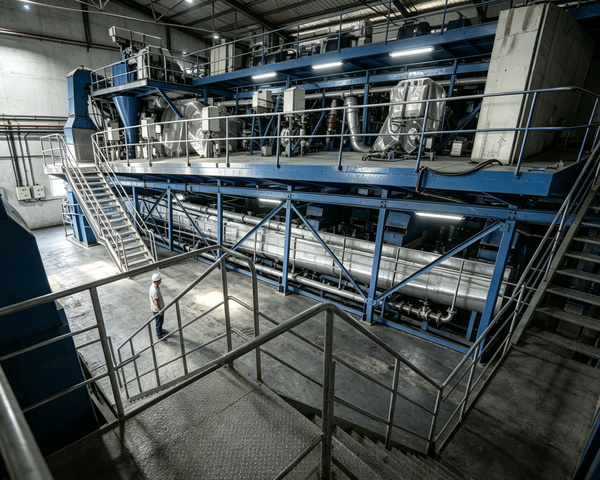
At a palm oil mill processing 800 tons of fresh fruit bunches (FFB) per day, roughly 14 tons of oil are lost during processing every single day. At current crude palm oil prices, that adds up to millions of dollars in hidden losses each year.
Industry data shows that total oil loss in a palm oil mill averages around 1.77% (based on FFB), broken down as follows: 0.45% from the sludge separator, 0.45% absorbed by empty fruit bunches, 0.55% retained in press fiber, 0.10% from sterilization condensate, another 0.10% from pipeline leaks or tank cleaning, 0.05% from kernel surfaces, and 0.05% from unstripped fruit bunches.
The three-phase decanter centrifuge is the key equipment for plugging the sludge “profit leak.” But choosing the right equipment is only the first step – understanding how site conditions determine centrifuge performance is where the real difference lies.
I. Where Exactly Is the Oil in the Sludge? – A Quantitative Breakdown
The crude palm oil mixture leaving the press enters the clarification stage. After hot water dilution and vibrating screen removal of coarse solids, the oil-water mixture settles and separates in the clarification tank. The sludge then flows to the sludge separator for further processing.
The core issue is this: sludge is not a simple “oil-water mixture” – it is a highly complex emulsion system. Research shows that palm oil in centrifuge sludge wastewater exists in three forms: approximately 30% as free oil droplets that can theoretically be separated directly by centrifugal force; approximately 56% as “bound oil” that requires cellulase treatment before it can be released; and the remainder in more complex bound forms.
This composition reveals a critical fact: increasing centrifugal force alone cannot recover most of the oil in sludge. That 56% of “bound oil” is encapsulated by cellulose and protein matrices, and the emulsion structure must first be broken before the centrifuge can do its job. This also explains why many mills still struggle with high sludge oil losses even after installing decanter centrifuges.
II. Site Conditions Determine Centrifuge Performance – Same Model, Two Completely Different Outcomes
Even when using the same three-phase decanter centrifuge, sludge oil loss can vary dramatically from mill to mill. A comparative study of two palm oil mills revealed a fact worth every mill manager’s attention: centrifuge performance is highly dependent on site conditions – even the same equipment model can perform completely differently at different mills.
Mill A’s Problem: Excessive Non-Oil Solids. Mill A’s feed contained high levels of non-oil solids (NOS). The excess solid particles occupied separation space inside the centrifuge, preventing effective oil separation and causing oil to be discharged along with the solid phase. The solution was not to replace the equipment, but to strengthen vibrating screen performance ahead of the clarification tank and optimize clarification tank retention time, allowing more solids to settle out before entering the centrifuge.
Mill B’s Problem: Unstable Emulsion. Mill B faced a completely different issue – high and fluctuating emulsion content in the feed, leading to increased oil loss in the heavy liquid phase. The solution was to check whether hot water dosage and temperature were appropriate, and if necessary, add heating or chemical demulsification pretreatment before the feed enters the centrifuge, breaking the emulsion structure first.
Key Takeaway: A decanter centrifuge is not a “plug-and-play” standardized piece of equipment. Customizing the operating strategy to your mill’s specific conditions is more effective at reducing oil loss than simply upgrading equipment.
III. Enzymatic Demulsification: Helping the Centrifuge Recover That “Hidden 56%”
If 56% of the oil in sludge exists as “bound oil” encapsulated by cellulose and protein matrices, then adding enzymatic pretreatment before centrifugation can significantly improve recovery rates.
A study published in the Journal of Oil Palm Research systematically examined the effect of cellulase treatment on palm oil recovery from sludge. The study used cellulase from Trichoderma reesei and optimized treatment conditions using response surface methodology. Results showed that under conditions of enzyme concentration 0.25, reaction time 81.46 hours, and agitation speed 111.05 rpm, the predicted oil yield reached 93.56%, with a validated experimental oil yield of 81.95%.
Another patented technology further defined the process window for enzymatic treatment: mixing a cellulase-active enzyme composition with palm sludge and incubating at 50°C to 95°C for 4 to 8 hours achieves effective demulsification and oil release.
This means that for sludge with a low proportion of free oil droplets and severe emulsification, enzymatic pretreatment can convert unrecoverable “bound oil” into “free oil” that the centrifuge can capture, further reducing sludge oil loss below 0.45%.
IV. Is This Investment Worth It? – An ROI Model Based on Real Data
Scenario Setup
Consider a medium-sized palm oil mill processing 500 tons of FFB per day, operating 330 days per year:
- Total oil loss: 1.77% × 500 tons/day × 330 days = 2,920.5 tons/year
- Sludge oil loss: 0.45% × 500 tons/day × 330 days = 742.5 tons/year
- Assuming crude palm oil price of approximately $800/ton (based on recent market averages)
Annual value of oil lost in sludge: 742.5 tons × $800/ton = approximately $594,000/year
Option 1: Install Three-Phase Decanter Centrifuge with Optimized Operation
Using heat exchange + high-speed centrifugal separation technology, total oil loss can be reduced from 1.0% to 0.5%-0.6%. Recovered oil purity can reach 99%, allowing direct return to the production line.
Based on recovering 0.3% FFB oil, annual recovery would be approximately 495 tons, worth approximately $396,000/year at $800/ton.
Option 2: Install a Complete POME Oil Recovery System
A real-world POME oil recovery project showed that a palm oil mill using a decanter centrifuge combined with an evaporation and concentration system recovered oil from palm oil mill effluent. The raw effluent contained approximately 1% oil, and the system recovered 50% of it, achieving annual recovery of 810 tons. The project’s payback period was 4 years.
Option 3: Integrated Circular Economy Solution
A techno-economic assessment of a 60-ton/hour capacity palm oil mill showed that integrating wastewater treatment, empty fruit bunch composting, and residual oil recovery into a unified process achieved:
| Metric | Value |
|---|---|
| Net Present Value | RM 75.63 million |
| Internal Rate of Return | 30.08% |
| Return on Investment | 19.20% |
| Payback Period | 5.21 years |
| Revenue Increase | 5% |
| CO₂ Reduction | 53% |
The core idea of this system is to convert waste streams into compost, biogas, and recovered oil, creating economic returns while delivering environmental benefits.
V. Huatai Palm Oil Processing Equipment Solutions
Henan Huatai Intelligent Equipment Group offers a complete equipment portfolio for palm oil extraction. Huatai’s independently developed palm fruit double-screw press (2-20 t/h capacity, residual oil in cake as low as 6%, equipped with PLC control and IoT remote monitoring), vertical palm fruit sterilizer (national patent ZL 2016 2 0745156.7), and palm kernel recovery system work in coordination with the three-phase decanter centrifuge in the clarification stage to form a complete palm oil processing line from FFB reception to crude oil clarification.
Huatai also provides clarification stage optimization solutions for mills, including sludge separator selection, operating parameter setting, and feed pretreatment recommendations. From equipment selection and process design to installation, commissioning, and personnel training, Huatai delivers complete turnkey engineering services, serving customers in over 130 countries and regions worldwide.
Final Thoughts
Oil losses in sludge don’t disappear on their own – but they don’t reveal themselves either. They hide in the emulsion, in the centrifuge parameter deviations, in the few degrees of temperature fluctuation in the feed. 1.77% total oil loss, 0.45% sludge oil loss – behind these percentages lies hundreds of thousands to millions of dollars in real annual profit.
More importantly, recovering oil from sludge is not simply a matter of “buying equipment.” Understanding site conditions, selecting the right pretreatment strategy, and calculating the return on investment – these are the keys to converting “hidden losses” into “visible profits.” If you are planning or optimizing a palm oil processing project, please contact Huatai Group for a clarification stage optimization solution and equipment configuration recommendations tailored to your mill’s specific conditions.